Building date: 1850-1851
Original use:
Corner structures:
Mortar application and content: Vertical pyramids
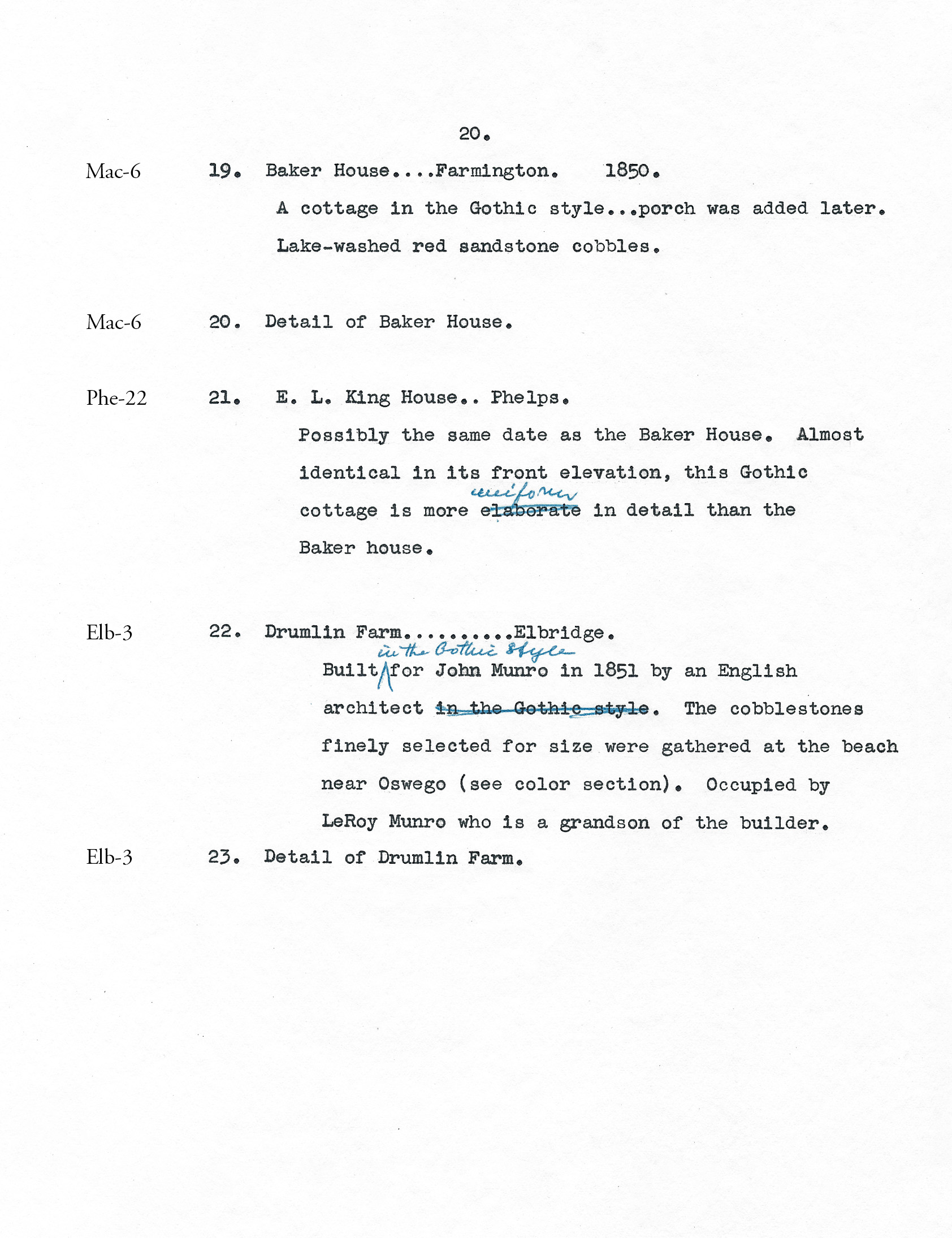
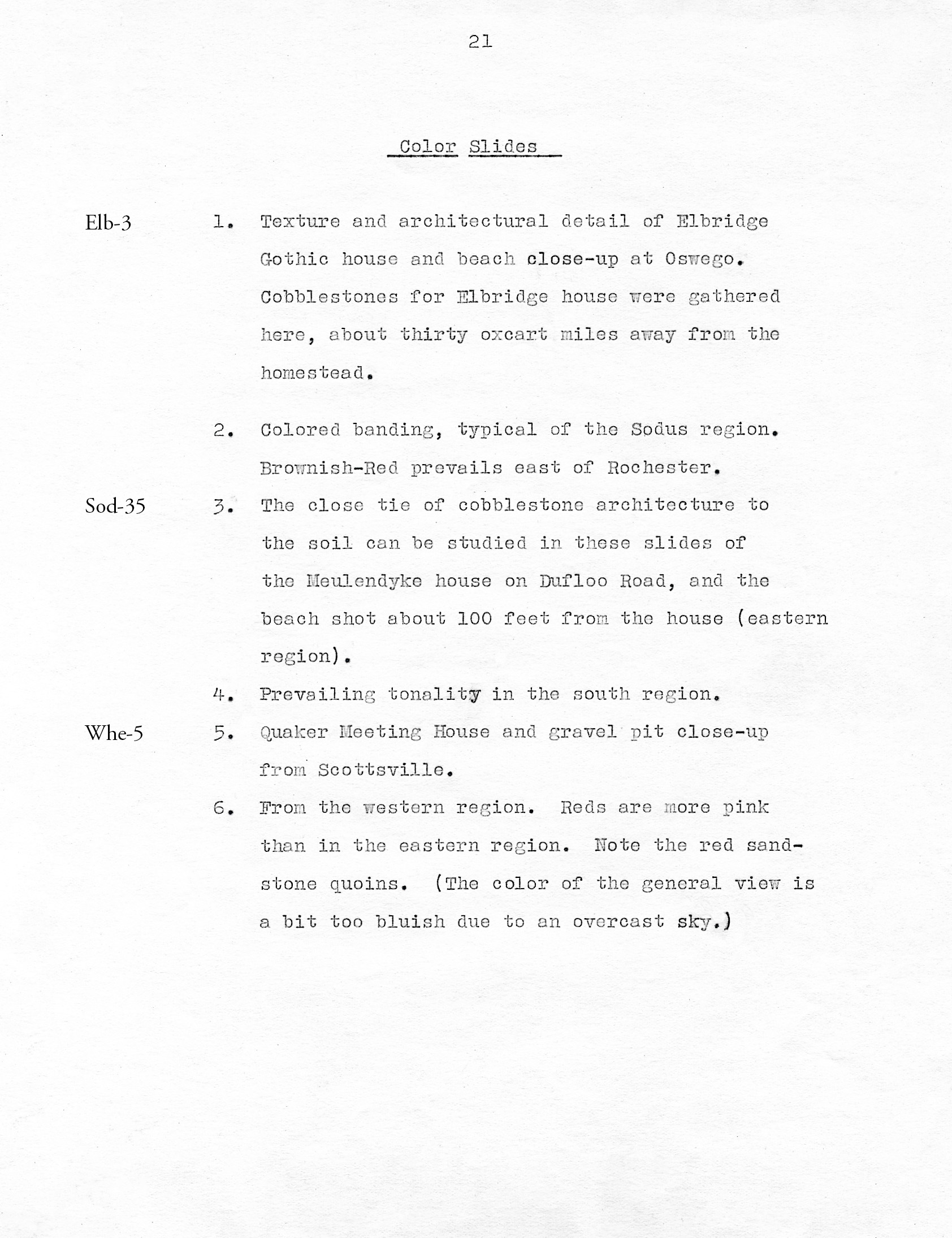
Types and uses of stones: Small, various colors, lake-washed cobblestones of igneous origin brought by wagon from the shore of Lake Ontario near Oswego< about 50 miles north of Elbridge.P> Types and choice of windows:
Structures with similar masonry details:
Masons who worked on building: Architect: Thomas Atkinson. Unique features: Gothic Revival. One of the finest cobblestone buildings in the state. It is a superb example of Gothic style. Built 1859-51. "Cobblestone Buildings in Onondaga County", 1992, Structure No. 2 compiled by Glenn Hinchey.
Map views courtesy Google Maps. Street level view is completely blocked by a row of cedar trees and other vegetation. Address is Google Earth confirmed; 43°01'57.39"N 76°27'57.34"W. Current owner of record, Drake as of the 2018 Tax Roll.
Town of Elbridge and Onondaga County Maps
Cobblestone house at the corner of Hamilton Road and Route 5 in Elbridge is considered a classic example of Gothic architecture. It was built by John Munro in 1850-51 with a slate roof. It was designed by Thomas Atkinson, an architect who came from England. It was built of washed cobblestones brought by wagon to the site from the shores of Lake Ontario near Oswego. Richard Palmer blog.
"The Cobblestone Houses of Upstate New York", compiled by Dorothy Wells Pease. Research done in collaboration with Hazel B. Jeffery, supplemented with material furnished by Carl F. Schmidt, 1941. Reference the fifth paragraph on page 41.
Story of the Munro Cobblestone House
On a hill well hidden behind a row of cedar trees on the north side Route 5 just west of the village of Elbridge, New York is one of the finest cobblestone houses of Gothic Revival architecture in the country. It was built for wealthy landowner John Munro in 1850-51 and was designed by internationally acclaimed architect, Thomas Atkinson, who came from England at Munro's request. He resided with the Munros for two years while it was constructed. It is believed Atkinson based his design on the British publication "Designs for Cottage and Villa Architecture"," by S.H. Brooks, 1839. Later Atkinson lived in Auburn, N.Y., where he built a Gothic Cottage at 24 Van Anden St. That house is now gone.
Editor's Note: Research in 1953 by Gerda Peterich states that architect Atkinson did not base this cobblestone structure design on the Brooks book. Peterich later publishes the article "Cobblestone Architecture of Upstate New York, Journal of the Society of Architectural Historians, XV, 2, providing additional information about architect Atkinson on page 16. An online search of British history found four architects with the name Thomas Atkinson. No USA hits on Thomas Atkinson. Note the Monro House was built 1850-51:Thomas Atkinson 1: 1729-1798 - obviously not the one.
Thomas Atkinson 2: 1774/5-1839 - not the one
Thomas Atkinson 3: 1799-1861 - not the one, the adventurer was traveling through Siberia, China and central Asia past 1853.
Thomas Atkinson 4: 1864-1948 - not the one, too late.None of the above lived where the Monro cobblestone house was built 1850-51, afterwards lived in Auburn, Cayuga County, NY, and had generations of Atkinsons to follow. This is important since there are few documented instances of an architect being involved in the construction of a cobblestone structure. So who was our Thomas Atkinson?
Erin Anheier, President of the Cobblestone Society and Museum did the genealogy research:
- ancestry.com: Thomas Atkinson and family is on the 1855 census for Elbridge. He was 35 and listed as a carpenter (not architect), his wife was Hannah [Wall]. They and the first two of their children were born in England. The youngest who was born in England was 8. The first child born in Onondaga was 2. They reported they had lived in the country for 2 years.
- Boyd's 1875 Auburn (NY) directory lists Thomas Atkinson, once again as a carpenter, living at 19 Van Anden in Auburn.
- 1905 Census - Thomas is age 85 and living with his son Walter's family in Auburn, Cayuga County, NY.
- findagrave.com: Thomas (1818-1908) and Hannah (1826-1895) are buried in Fort Hill Cemetery in Auburn, Cayuga County, NY.
Letter written in 5/13/1953 to Gerda Peterich from Earl T. Atkinson, Canandaigua, NY provides the family relationship to Earl: Grandfather Thomas Atkinson, Father Walter Thomas Atkinson.
The Munro house has been meticulously preserved through the years. Laid out on an H plan, the house is covered by a steep slate roof, pierced in the center by a small gable. The multiple flues of the square chimneys are set diagonally and blend with the diamond-shaped glass panes preserved in all the windows. The cobblestone masonry is of superior quality, consisting of lake-washed cobblestones laid six rows to a quoin with a "bead" joint between the rows. Cobblestones, picked off the shore of Lake Ontario near Oswego, are well preserved. There are a few red sandstone cobbles mixed in, but the general tonality of the walls is greenish-gray. The home is a testament to Atkinson's skills.
The original woodwork and fireplaces are still preserved. Although some minor changes were made in order to install modern heating and other conveniences, owners have taken great care to preserve the original character and details. The book Architecture Worth Saving in Onondaga County, identified the cobblestone house as "perhaps the most important Gothic Revival building in Onondaga County." It said: "This cobblestone Gothic Revival building, standing amid century-old hard maples on an expansive site, crowning a gentle rise with a skyline of gables and chimneys, is more than a farmhouse; it must be included with Whig Hill and Roosevelt Hall as one of three county country houses in the grand manner, the tradition of the great country estates."
The late Mary Munro, who grew up there, was the last of the family to live there. When interviewed in the mid 1960s, her white hair, sparkling eyes, dignified bearing, and gentle manner reminded one that advancing years bring charms of their own. Not the least of those charms was the ability to recall the distant past. As a Munro, she was frequently consulted by historical researchers, but she modestly referred most queries to her more historically-minded cousins in Marcellus and Baldwinsville. But while studying at Columbia Teachers College, she wrote a paper for a sociology class that is interesting document of local history. Entitled Quarter Century with a Central New York Farmer: 1846 - 1871, the paper tells the story of life on the Munro farm. The principal reference sources for the paper were farm journals kept by John Munro, the grandson of Squire Munro and her grandfather.John Munro built the cobblestone house in 1850. In this still-magnificent home, now owned by Dr. and Mrs. William B. Drake, Mary Munro grew up.
Pondering her grandfather's reasons for building the 17-room house, Mary Munro wrote: "When one considers that 11 men were probably lodged and boarded, and that there were also, in all likelihood, two, or perhaps three hired girls, one can see why larger quarters were desirable. Evidently, also, grandfather had political ambitions, and perhaps felt the need of a more pretentious home as one fitting his position. His family was growing. Much entertaining was done, and he no doubt felt that this would increase as his children grew older. The book Architecture Worth Saving in Onondaga County, offered a different hypothesis: "Perhaps the reminiscence of aristocratic English country life is less attributable to the pretentiousness of Yankee farmer John Munro than to the taste of English architect, Thomas Atkinson."
The cobblestones were drawn from Lake Ontario by sleigh, according to Miss Munro, and the wood was all taken from the farm. The woodworking was done on the premises. This was working farm. John Munro was a "gentleman farmer," to be sure. He had hired men to do the farm work. But the Munros were not the "idle rich." John Munro kept busy attending to the many details of his large household and his many enterprises.
Miss Munro wrote that her grandfather spent a good deal of time making purchases in surrounding villages. "Evidently no one community was adequate for all needs" she wrote. "On the same day he frequently went to three different places for as many purchases, as on one day he went to Jordan for groceries, to Elbridge for the mail, and to Mottville for cultivator teeth." John Munro also spent a good deal of time at the sawmill owned by him and his brother Daniel. "Collections and deliveries were necessary," she wrote, "and calls were made to notify people that their lumber was ready. Notes were paid, and money loaned to other neighbors..."
That is not to say that social life was neglected. "He and Eveline, his wife, would go to town for groceries but spend the afternoon visiting with some friend, perhaps 'staying for tea,'" she wrote."...very large parties were quite common, especially on anniversaries or special holidays...fifty or sixty people attended those gatherings, and grandfather states that they 'had a very enjoyable time.'" John Munro was very active in church work. "Probably there is no one thing outside of this work which is mentioned oftener," Mary wrote. "Besides attending services and prayer meetings, he devoted a great deal of time to soliciting and collecting, attending conventions, and making out reports. Miss Munro recorded many other activities of her grandfather."
As trustee of the one-room school in 1858, he hired the teacher for $4.75, she agreeing to board herself. Then, too, there were miscellaneous tasks which claimed his attention - many of which today would be performed by a lawyer, or other specialist. He drew up deeds and mortgages, made contracts, and surveyed land. He went to Syracuse to see about revocation of a tavern license. He sat on a local jury when offenses were tried, a man being fined $800 for selling boys strong drink, and another man being declared incompetent because he was an "habitual drunkard." Munro was also a member of the "Society for Detecting Horse Thieves" and once went to help look for a murderer.
"As supervisor in 1860, he had the job of doctoring the poor. From 1860 to 1871, grandfather seemed to become more and more interested in public affairs." All of this was in addition to the household chores, which Munro evidently helped with: "putting down" hams and beef in salt, drying apples, boiling cider, making soap, gathering bark for coloring, helping with dyeing, having rugs woven, gathering herbs for medicine, dipping candles, doing the wash, making clothes, slaughtering livestock and making sausage, household repairs, tending the garden - all were chronicled in John Munro's farm journal.
The farm must have been a vast enterprise. Munro raised and sold grass seed, millet, flax, buckwheat, broomcorn, oats, barley, wheat, rye, and corn. Sheep were raised for wool. Large numbers of cows and hundreds of pigs were on the farm, as well as turkeys, geese, and chickens. In December, 1851, Munro recorded the sale of about 300 pounds of chickens and turkeys plus 31 geese. In 1856, he mentioned having 500 hogs. Munro also tried raising unusual crops. In 1864 the journal noted sugar cane was "cut and the juice extracted, there being three pails full which boiled down to four quarts of syrup. " He raised tobacco from 1851 on and "at one time he hired men to make his tobacco into cigars. " The farm hands gathered hickory nuts, black walnuts, butternuts, and chestnuts, and bees were kept for several years. Miss Munro remarked on the low wages paid hired men: "In 1847 he paid $1.00, $8.00 and $10.00 a month to different men. The following year he paid $12.00 and $13.00. Even as late as 1900 we know men worked for $25.00." She also noted that bartering was common. "Goods were seldom paid for by giving cash, and some of the exchanges seem very peculiar. In 1857, a harness bought at $32, was payable in wood at $3 a cord." She quoted a notation about another exchange: "I have taken from Mr. Shanahan the pony which satisfied the judgment I obtained against him for damages by his hogs and cattle. I traded the pony for a two-horse wagon made from an old stage coach." "Later he traded a pair of mules for a horse, thirty-seven pounds of salt, seventy-two pounds of candles, and one hundred thirty-two pounds of hard soap!" Miss Munro wrote.
John Munro died in 1900, having moved into the village of Elbridge. The year before he had turned the farm over to his son Frank, Mary's father. Mary, then 7, called that house home until 1963, when the farm was sold out of the family. Miss Munro had a long career as a school teacher. She graduated from Geneseo Normal School and spent several summer sessions at Columbia Teachers College in New York City. From about 1914 to 1918 she taught at the Hart Lot School; she spent the next four years teaching fifth, sixth and seventh grades in Elbridge. Then she taught at Baldwinsville and finally went to Cazenovia, where she taught for 17 years. She spent most summers at the Elbridge farm. After she retired from teaching in New York State, she went to Colorado where she taught for 12 years. Miss Munro remembered that there were about 30 students in a class and that "they were no particular trouble." Mary's brother, LeRoy, took the farm over from their father and raised purebred Holsteins. After the death of LeRoy's wife in 1962, Miss Munro moved home from Colorado to keep house for her brother. In 1963, they sold the farm and moved up the road to a new house. Miss Munro died Dec. 20, 1981, at the age of 90. Richard Palmer blog.
"The John Monroe House", Route 5, West of Elbridge, New York, 1850. Architecture Worth Saving in Onondaga County, 1964, pages 59-63, NYS Council on the Arts, Syracuse University.
"The Monroe House at Elbridge, New York", by Gerda Peterich, Central New York Architectural Historians Fall Meeting, page 3, Syracuse, New York, October 30, 1965.
"The Geological Origin of Cobblestone Architecture", by Gerda Peterich. Specific references to this structure on pages 20, and 21.
"Cobblestone Architecture in the Rochester Area", by Gerda Peterich, 1953. Reference Residence of Leroy Monro and figures 51-54. Editor's Note: This digitized version of the original typescript manuscript is reformatted for digital display, edited for errors, and includes blue tinted highlighted links to improve access within the document, to the appropriate structure pages in the Cobblestone Info Base, or to external resources on the internet. This document is one of two known typescript drafts, likely a thesis or essay bound as a book and apparently never published. One is available in the Cobblestone Museum Resource Center, the other in the University of Rochester Art and Music Library. A companion or precursor typed paper of the same title exists, perhaps used for a talk and/or photographic display of cobblestone structures.
Realty website: "House of the Week": Elbridge cobblestone has been called 'one of the most important' buildings in Onondaga County. By Johnathan Croyle | jcroule@syracuse.com Posted Dec 25, 2020, Syracuse.com.
- "Cobblestone Architecture of Upstate New York", by Gerda Peterich, Journal of the Society of Architectural Historians, Vol 15, Issue 2 1956, Pages 16, and 17. By permission of the University of California Press, "The requested material is in the public domain and you are welcome to use it."
- "Cobblestone Masonry", 1966, Carl Schmidt: Name reference, Munro House
- Page 91
- "Cobblestone Landmarks of New York State", 1978, by Olaf William Shelgren, Jr., Cary Lattin, and Robert W. Frasch, Photographs by Gerda Peterich: Name reference, Munro House
- Pages 146 - 148
- "The Era of Cobblestone Architecture", unpublished manuscript 1972. To access the manuscript content about this structure, see 65. Onondaga County, Monro-Beckwith House, and 185. Entrance Wing: Monro-Beckwith House.


¹ Photographs courtesy Library of Congress
² Image courtesy Cobblestone Museum.
³ Photography courtesy Gerda Peterich. Cobblestone Museum.
4 Photography courtesy Martin and Sheila Wolfish.
5 Photography courtesy Richard Palmer.
